
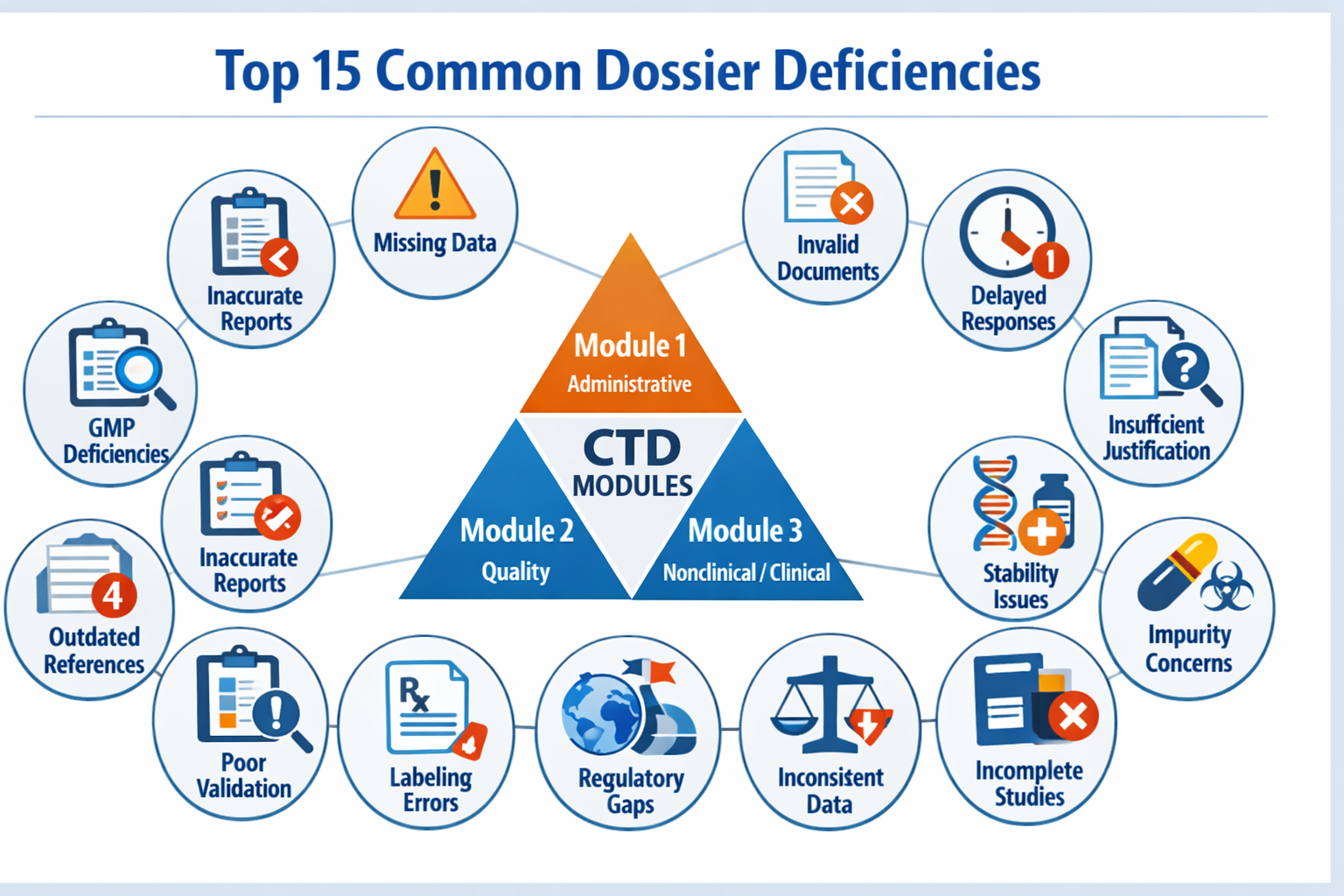
Regulatory dossier submissions are the single most critical step in securing market authorization for a pharmaceutical product. However, a staggering number of applications encounter delays – or outright rejection – not because of a product’s safety or efficacy, but because of avoidable common dossier deficiencies. Therefore, recognizing the top 15 common deficiencies found during regulatory dossier review is the first step toward a smooth, first‑cycle approval. This article draws on current ICH, ASEAN, FDA, and EMA expectations12 to help you identify and eliminate these pitfalls before they derail your submission.
Why Common Dossier Deficiencies Delay Market Access
Every query raised by a health authority consumes time, resources, and sometimes the entire filing window. Specifically, regulatory agency data consistently show that over 60% of initial CTD/ACTD applications receive deficiency letters, with many queries rooted in the same recurring common dossier deficiencies.3 Consequently, when you understand these mistakes, you shift from a reactive firefighting mode to a proactive, right‑first‑time submission strategy.
Moreover, a single oversight in Module 3’s stability data or an incomplete administrative form can trigger a clock‑stop, eroding patent life and costing sponsors millions. The ICH M4 guideline, the ASEAN Common Technical Dossier (ACTD) format, and regional directives all underscore that completeness, consistency, and clarity are non‑negotiable.14
Common Dossier Deficiencies: An Overview of the Top 15
Below are the 15 most frequent deficiencies identified during regulatory dossier reviews globally. They span all CTD modules and apply equally to the ACTD, eCTD, and paper‑based submissions. In addition, for each entry you’ll find the specific regulatory concern, the impacted module, and actionable advice.
Summary Table of Top 15 Common Dossier Deficiencies
| Deficiency | Module Most Affected | Consequence |
|---|---|---|
| 1. Incomplete or outdated administrative forms | Module 1 | Immediate rejection or request for amendment |
| 2. Mismatch between product information and supporting data | Module 1, 2 | Confusion, additional queries, delayed approval |
| 3. Lack of proper CTD structure and navigation | All Modules | Rejection due to format non‑compliance |
| 4. Inadequate drug substance characterization | Module 3 | Major deficiency, often requiring new studies |
| 5. Missing or insufficient specification justifications | Module 3 | Unacceptable quality control, clock‑stop |
| 6. Stability data that does not cover proposed shelf‑life | Module 3 | Shorter shelf‑life granted or full rejection |
| 7. Incomplete process validation data | Module 3 | Manufacturing site not approved |
| 8. Missing bioequivalence or clinical bridging data | Module 5 | Refusal to accept generic/hybrid application |
| 9. Inconsistent batch numbering across modules | Module 3, 4, 5 | Data integrity concerns, full audit |
| 10. Unclear risk assessment for impurities | Module 3 | Safety concerns, request for further tox data |
| 11. Outdated or non‑ICH compliant nonclinical studies | Module 4 | Full rejection of nonclinical package |
| 12. Deficient clinical overviews lacking critical analysis | Module 2 | Misinterpretation of benefit‑risk, refusal |
| 13. Failure to address regional regulatory specifics (e.g., ACTD vs CTD) | Module 1, All | Outright rejection in ASEAN, GCC markets |
| 14. Inaccurate or missing GMP certificates | Module 1 | Manufacturing authorization denied |
| 15. Poor cross‑referencing between modules and appendices | All | Lengthy review cycles, multiple deficiency rounds |
A Common Dossier Deficiency: Incomplete or Incorrect Administrative Forms
Module 1 is the face of your application. Yet reviewers frequently encounter outdated application forms, missing signatures, incorrect product names, or wrong dosage form codes. For instance, in ACTD submissions for ASEAN, a common dossier deficiency is using a CTD Module 1 template instead of the specific ASEAN variation.4 Similarly, in the EU, missing the electronic application form (eAF) or providing inconsistent contact details triggers immediate rejection.2
How to avoid it: Always download the latest form directly from the authority’s website on the day of submission. Then, cross‑check every field against the dossier content. A regulatory consulting team like Pharma Actd Dossiers can perform a granular administrative pre‑review to catch these simple but fatal errors.
Mismatch Between Product Information and Supporting Data
The SmPC, package insert, and labeling must be precisely mirrored in Modules 3, 4, and 5. Specifically, a difference in the stated strength, storage condition, or therapeutic indication between the product information and the corresponding quality or clinical data is a top‑5 deficiency.5
Preventive measure: After dossier compilation, conduct a line‑by‑line reconciliation of product information text against every summary, table, and study report. Additionally, use a traceability matrix.
Structural and Navigational CTD Non‑Compliance
A dossier that does not follow the ICH M4 Granularity Document or the specific eCTD backbone is administratively incomplete. For example, missing bookmarks, hyperlinks, or a consistent table of contents are common dossier deficiencies.1 Meanwhile, in ASEAN, submissions not adhering to the ACTD organizational structure (Part I, II, III, IV) are returned.4 The FDA’s refusal‑to‑file (RTF) statistics frequently cite poor navigability.
Checklist item: Validate the dossier with an eCTD viewer before submission. Then ensure all headings match the authority’s required table of contents exactly.
Inadequate Drug Substance Characterization
Under Module 3.2.S, elucidation of structure, isomerism, polymorphic forms, and particle size distribution is essential. However, regulators often see missing data on potential genotoxic impurities, insufficient characterization of starting materials, or a lack of discussion on stereochemistry.6 As a result, FDA and EMA regularly issue major deficiency letters when critical physicochemical properties are not fully described.
Solution: Perform a gap analysis against ICH Q6A, Q3A, and Q3B. Moreover, include decision trees that justify why certain tests were not performed.
Missing or Unjustified Specifications
Setting acceptance criteria without linking them to batch data, stability results, and clinical experience is a frequent Module 3 deficiency. For instance, a dissolution specification of Q=80% at 30 minutes must be justified with a dissolution profile comparison and in vivo relevance.7 In addition, health authorities such as CDSCO and EMA demand explicit justification for every specification parameter.
Pro tip: Include a specification justification table that maps each limit to a regulatory guideline, development data, or pharmacopoeial monograph.
Stability Data That Does Not Support the Proposed Shelf Life
One of the most severe common dossier deficiencies is proposing a 24‑month shelf life with only 12 months of long‑term data and no adequate intermediate or accelerated extrapolation. However, ICH Q1E requires that extrapolation be scientifically sound.8 Likewise, ASEAN ACTD guidelines demand at least 12 months of long‑term data at the time of filing for a 24‑month shelf life, with a commitment to continue studies.4
Action: Always present stability commitment protocols and complete statistical analysis. Therefore, if extrapolating, provide a robust justification as per ICH Q1E.
Incomplete Process Validation Data
Module 3.2.P.3 must demonstrate that the commercial manufacturing process is under control. Consequently, missing or incomplete process validation protocols, lack of critical process parameter identification, or absence of hold‑time studies are common queries.9 Specifically, for sterile products, insufficient media fill data is a critical deficiency leading to rejection of the site.
Best practice: Include a comprehensive process validation master plan and, where available, full validation reports for three consecutive commercial‑scale batches.
Missing Bioequivalence or Clinical Bridging Data
For generics and hybrid applications, failure to provide a complete bioequivalence study report with statistical analysis is a top reason for refusal.10 Additionally, when a product differs from the reference in excipients, missing data on comparative dissolution in multiple media under Module 3.2.P.2 creates a deficiency chain. Moreover, ASEAN authorities under the ACTD consistently query the lack of a biowaiver justification if a BE study is not conducted.
Key deliverable: Include the full BE study report, randomisation code, analytical method validation, and supporting comparative dissolution data across at least three media (pH 1.2, 4.5, 6.8).
Inconsistent Batch Numbering and Traceability
Data integrity is paramount. In fact, if the batch numbers used in the development pharmaceutics section do not match those in stability studies or clinical batches, regulators lose confidence. For example, a typical deficiency states, “The batch number referenced in the dissolution method validation (Module 3.2.P.5) cannot be traced back to the manufacturing process development section.”
Remediation: Create a batch genealogy table that clearly shows which batch was used for each study and confirm it aligns across all modules.
Unclear or Non‑Compliant Impurity Risk Assessment
ICH M7, Q3A, and Q3B require a rigorous risk assessment for actual and potential impurities. Meanwhile, missing a discussion on elemental impurities (ICH Q3D) or nitrosamines (as per EMA/FDA guidance) is now one of the fastest ways to receive a major deficiency.1112
Checklist: Include a nitrosamine risk assessment report, elemental impurity risk assessment, and justification for specified/unspecified impurity limits based on toxicology data or TTC.
Outdated or Non‑ICH Compliant Nonclinical Studies
Module 4 must demonstrate GLP compliance and adherence to ICH S guidelines. However, many submissions from emerging markets contain repeat‑dose toxicity studies that do not follow the ICH M3(R2) timelines or lack proper TK data.13 As a result, an unvalidated bioanalytical method in a pivotal tox study is an instant rejection point.
Review protocol: Map every nonclinical study to the relevant ICH safety guideline and provide a GLP compliance statement for each.
Deficient Clinical Overviews Lacking Critical Analysis
Module 2.5 and 2.7 require more than a simple listing of studies. In fact, a poor clinical overview that fails to present a critical benefit‑risk evaluation, omits discussion of safety signals, or does not address the data in the context of the targeted patient population is a common deficiency.14 Consequently, EMA assessment reports often criticize the lack of a meaningful integrated efficacy and safety summary.
Enhancement: Ensure the clinical overview is written by a qualified medical writer and includes a structured benefit‑risk assessment using the FDA’s Benefit‑Risk Framework or EMA’s tool.
Failure to Address Regional Regulatory Specifics
Submitting a pure ICH CTD to an ASEAN country that requires the ACTD format is a fatal mistake. Likewise, the same applies to GCC, where country‑specific requirements for Module 1 (e.g., legalized GMP certificates, pricing certificates) are non‑negotiable.4 Furthermore, in India, CDSCO expects specific appendices like a complete drug master file copy.
Regional intelligence: Always consult the latest country‑specific guidelines. Pharma Actd Dossiers specializes in bridging the gap between global CTD content and regional ASEAN/ACTD requirements, ensuring that every local nuance is satisfied before submission.
Inaccurate or Missing GMP Certificates
Module 1 must contain valid, current GMP certificates for all manufacturing and testing sites. Specifically, a certificate that has expired by even one day, or is not appropriately apostilled/legalized for the target country, will halt the review.2 Similarly, for EMA, a missing manufacturing authorization or an incorrect EU GMP certificate number is a ground for validation refusal.
Control: Implement a certificate tracker with expiry dates and legalization status for every market.
Poor Cross‑Referencing Between Modules
A dossier that forces the reviewer to search for information creates frustration and delays. For instance, inconsistent table references, missing appendix identifiers, or vague statements like “refer to the clinical study report” without specifying exact sections are frequent issues. Therefore, the ICH eCTD specification mandates detailed hyperlinking and unique document identifiers.1
Fix: Use the authority’s suggested table of contents and populate all section titles exactly. Then, cross‑check every internal reference and hyperlink using an automated validation tool.
How to Proactively Eliminate Common Dossier Deficiencies
Avoiding common dossier deficiencies requires a structured quality control approach:
- Pre‑submission gap analysis against the specific regulatory checklist (FDA CTD checklist, EMA validation checklist, or ACTD compliance guide).
- Internal peer review by a team not involved in authoring the dossier.
- Use of regulatory intelligence tools to stay updated on new requirements (e.g., nitrosamines, elemental impurities, e‑labeling).
- Mock review simulating an agency assessment.
- Partner with specialized consultants – a firm like Pharma Actd Dossiers can act as an independent reviewer, applying a fresh, authority‑like lens to your submission.
Conclusion
The common dossier deficiencies outlined above are largely preventable. In summary, they stem from incomplete data, format errors, and failure to interpret guidelines correctly. Therefore, by understanding each deficiency and implementing a rigorous pre‑submission checklist, you protect your product’s timeline and budget. Ultimately, whether you are filing in a stringent regulatory market or navigating the ACTD for ASEAN, a right‑first‑time submission is always the goal.
Moreover, when the stakes are high, partnering with experts can make the difference between a query‑free approval and a costly rejection. At Pharma Actd Dossiers (visit www.pharmaactddossiers.com), we specialize in identifying and resolving common dossier deficiencies before they become regulatory roadblocks. Contact us today to ensure your next submission is your smoothest one yet.
Frequently Asked Questions
- 1. What are the most common CTD dossier deficiencies?
- The most common CTD deficiencies include incomplete Module 1 forms, poor cross‑referencing, insufficient stability data, missing impurity risk assessments, and non‑compliant product information. Indeed, these mirror the top common dossier deficiencies listed above.
- 2. How can I check if my dossier is ready for submission?
- Use a regulatory submission checklist aligned with the target authority (e.g., FDA’s Module 1 checklist, EMA’s eCTD validation criteria, or ASEAN ACTD compliance list). Additionally, a mock review or independent gap analysis by regulatory professionals is highly recommended.
- 3. What is the difference between CTD and ACTD deficiencies?
- While scientific and quality data expectations are similar, ACTD deficiencies often arise from not following the ASEAN‑specific structure (Part I‑IV), lacking local administrative documents, or failing to meet ASEAN stability zone requirements (Zone IVb). On the other hand, CTD submissions in ICH regions have more stringent electronic formatting and hyperlinking requirements.
- 4. Can a minor deficiency lead to full dossier rejection?
- Yes. In fact, multiple minor deficiencies in administrative sections can lead to a refusal to file. Even worse, a single major deficiency, such as incomplete stability data or missing GMP certificates, can result in a clock‑stop or rejection.
- 5. How do I fix a deficiency after receiving a query?
- Respond point‑by‑point in a clear table, provide the updated documents with tracked changes, and explain the impact on other sections. Most importantly, timeliness is critical; always meet the authority’s response deadline to avoid automatic withdrawal.
- 6. Are ACTD submissions reviewed differently from CTD submissions?
- The scientific review is comparable, however, ACTD requires paper or electronic submission in a specific binder structure. Consequently, reviewers in ASEAN countries place high importance on administrative completeness, local legalized documents, and compliance with country‑specific product registration requirements.
- 7. How often do deficiency trends change?
- Deficiency trends evolve as new guidelines emerge (e.g., nitrosamine evaluation, elemental impurities, e‑labeling). Therefore, it is vital to monitor updates from ICH, WHO, FDA, EMA, and regional bodies regularly.
Real‑World References
- ICH M4 (R4) Guideline – Common Technical Document for the Registration of Pharmaceuticals for Human Use. International Council for Harmonisation.
- EMA Pre‑submission Guidance for Applicants. European Medicines Agency.
- FDA Center for Drug Evaluation and Research. Refuse to File: NDA and BLA Submissions (Guidance for Industry). 2017.
- ASEAN Common Technical Dossier (ACTD) for the Registration of Pharmaceuticals for Human Use. ASEAN Secretariat.
- EMA/CHMP. Notice to Applicants – Volume 2A: Procedures for Marketing Authorisation. Chapter 7.
- ICH Q6A – Specifications: Test Procedures and Acceptance Criteria for New Drug Substances and New Drug Products.
- FDA Guidance: Dissolution Testing of Immediate Release Solid Oral Dosage Forms.
- ICH Q1E – Evaluation of Stability Data.
- ICH Q7 – Good Manufacturing Practice Guide for Active Pharmaceutical Ingredients and regional process validation guidance (e.g., FDA 2011 Process Validation Guideline).
- FDA Guidance: Bioequivalence Studies with Pharmacokinetic Endpoints for Drugs Submitted Under an ANDA.
- EMA/CMDh – Nitrosamine impurities guidance (EMA/CMDh/410827/2020) and FDA Guidance Control of Nitrosamine Impurities in Human Drugs (2021).
- ICH M7 – Assessment and Control of DNA Reactive (Mutagenic) Impurities in Pharmaceuticals; ICH Q3D – Guideline for Elemental Impurities.
- ICH M3(R2) – Guidance on Nonclinical Safety Studies for the Conduct of Human Clinical Trials and related ICH S guidelines.
- ICH E3 – Structure and Content of Clinical Study Reports; EMA/CHMP Guideline on the Clinical Overview.
Additional Resources & Related Services
- ACTD Dossier Preparation & Compilation Service
- Regulatory Gap Analysis & Pre‑Submission Audit
- eCTD Publishing & Submission Management
- Query Response & Deficiency Resolution Service
- Regional Registration Support (ASEAN, GCC, Africa)
Disclaimer: This article is for informational purposes only and does not constitute regulatory advice. Always refer to the official guidelines and consult with qualified regulatory professionals.
