
Are you planning to expand your pharmaceutical exports? If so, you must understand the critical differences between regulatory submission formats. Specifically, choosing the right ACTD vs CTD dossier format can determine the success or failure of your product registration. Navigating global regulatory requirements is complex. However, this comprehensive guide will simplify the process. We will break down the structures, target markets, and specific requirements of both formats. By the end, you will know exactly which format your product needs for a smooth, first-time approval.
Understanding the Basics: What is a Pharmaceutical Dossier?
A pharmaceutical dossier is not merely a stack of paperwork. Rather, it is a comprehensive, scientifically rigorous narrative. Regulatory agencies use this document to evaluate the safety, efficacy, and quality of a drug. Consequently, any error in compilation can lead to severe delays or outright rejection.
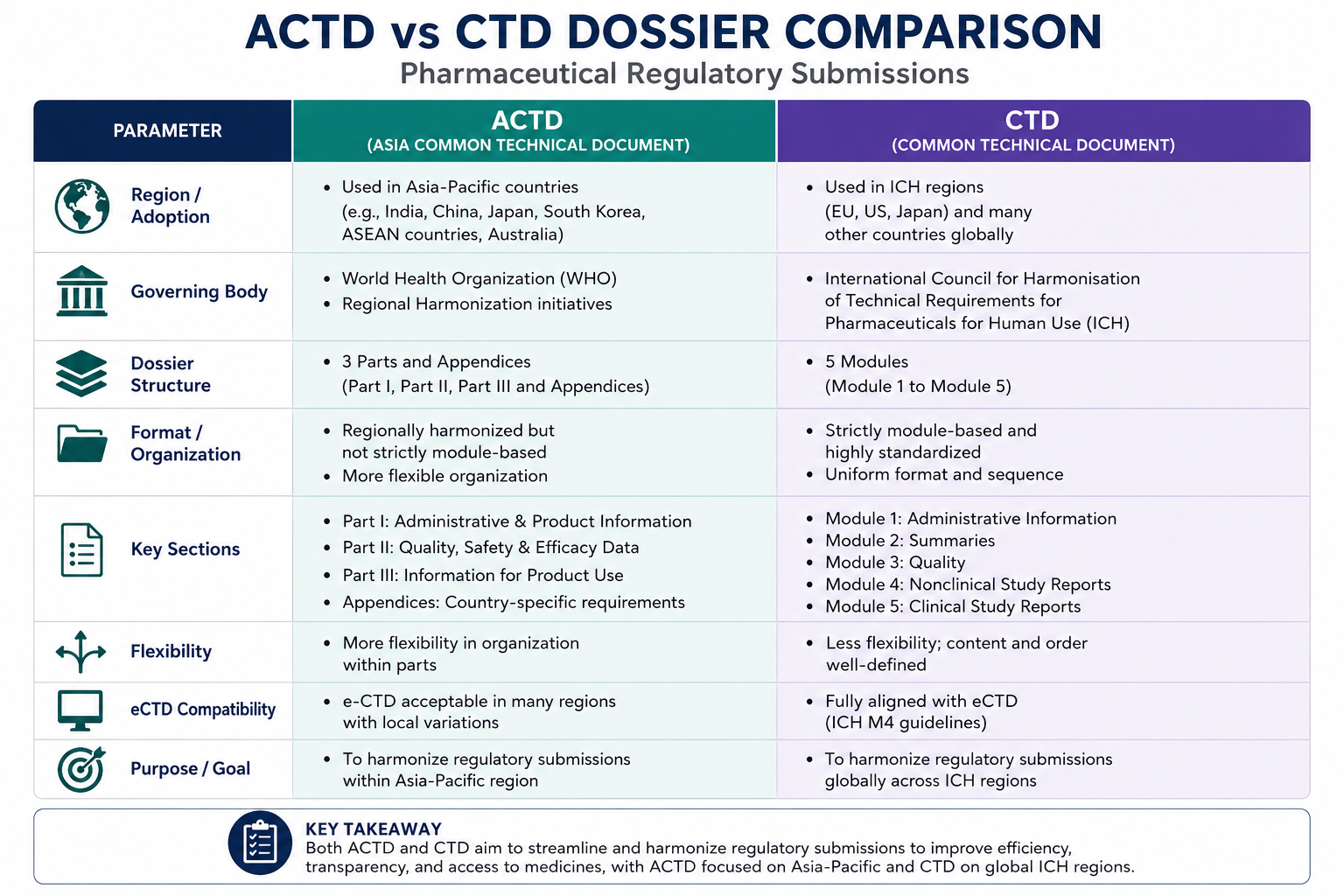
Historically, every country demanded a unique documentation format. This fragmentation caused massive inefficiencies for pharmaceutical manufacturers. Fortunately, global harmonization efforts emerged to solve this problem. Today, the two most prominent standardized formats are the ASEAN Common Technical Dossier (ACTD) and the International Council for Harmonisation (ICH) Common Technical Document (CTD). Understanding the ACTD vs CTD dossier distinction is the first step toward global market access.
What is the ACTD Format?
The ASEAN Common Technical Dossier (ACTD) is a standardized format. It was developed specifically for the registration of pharmaceutical products in ASEAN member states. These countries include Indonesia, Malaysia, Thailand, Vietnam, the Philippines, and Singapore. The primary goal of the ACTD is to harmonize regulatory requirements across Southeast Asia.
Key Features of ACTD
- Four-Part Structure: Unlike the CTD, the ACTD is divided into four distinct parts.
- Heavy Emphasis on QOS: Part II (Quality Overall Summary) requires a highly detailed, critical evaluation of the data, not just a repetition of facts.
- Zone IVb Stability: Stability data must strictly comply with ASEAN Zone IVb conditions (30°C ± 2°C / 75% RH ± 5%).
- Flexibility for Generics: The ACTD is highly optimized for generic drug registrations, streamlining the clinical data requirements if bioequivalence is proven.
Target Markets for ACTD
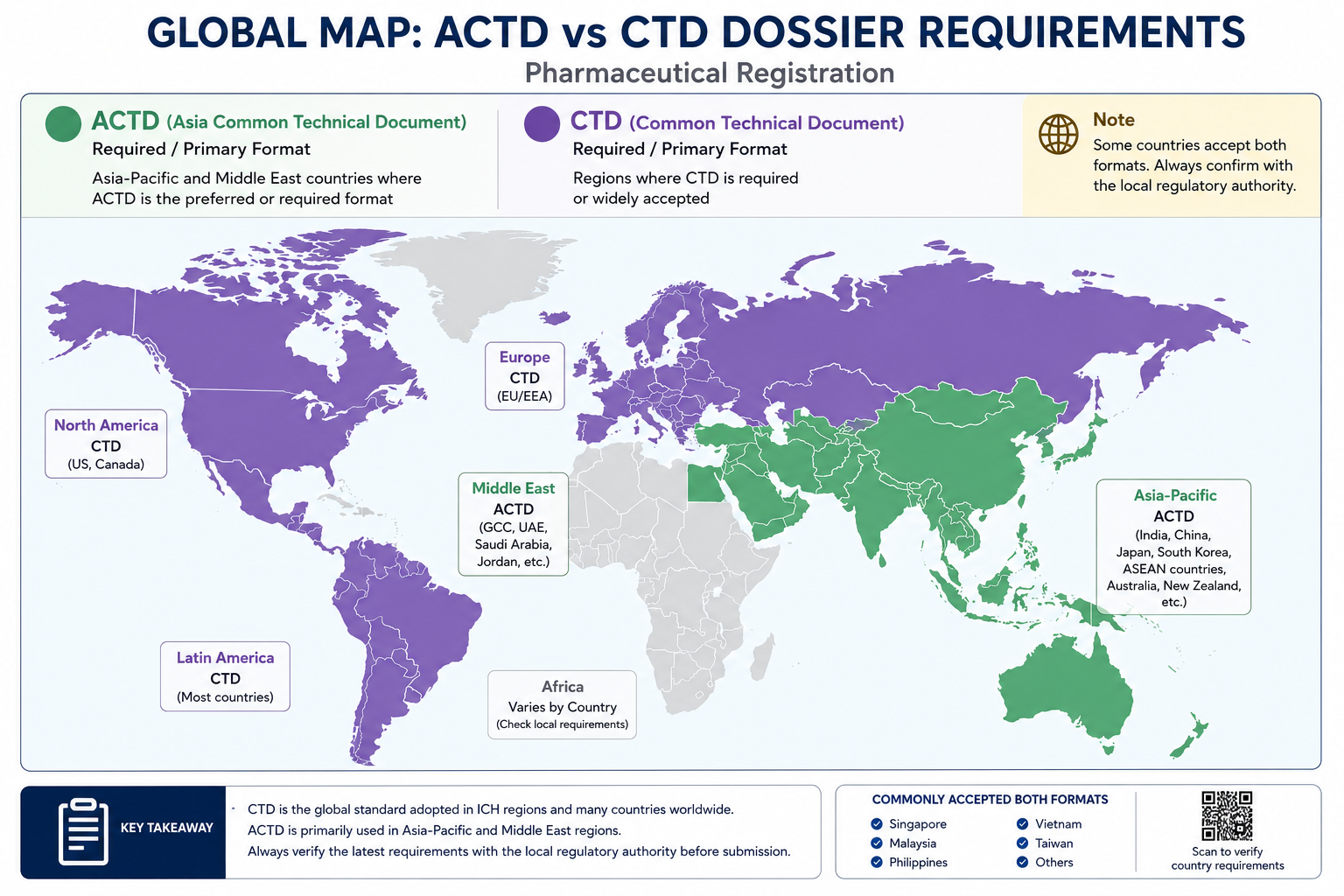
You must use the ACTD format if your primary export destinations are within the ASEAN region. For instance, the National Pharmaceutical Regulatory Agency (NPRA) in Malaysia and the BPOM in Indonesia strictly mandate this format for product registration.
What is the CTD Format?
The Common Technical Document (CTD) is the internationally agreed-upon format for the registration of pharmaceuticals. It was developed by the International Council for Harmonisation of Technical Requirements for Pharmaceuticals for Human Use (ICH). Therefore, it represents the global gold standard for regulatory submissions.
The 5-Module Structure of CTD
The CTD is organized into five logical modules. This pyramid structure ensures that reviewers can easily navigate the data:
- Module 1: Regional Administrative Information. This includes country-specific forms, labeling, and prescribing information.
- Module 2: CTD Summaries. This contains high-level overviews, including the Quality Overall Summary (QOS), non-clinical overviews, and clinical overviews.
- Module 3: Quality. This module provides exhaustive details on the drug substance and drug product, including manufacturing processes and analytical validation.
- Module 4: Non-Clinical Study Reports. This contains pharmacology and toxicology study data.
- Module 5: Clinical Study Reports. This includes all human clinical trial data and bioequivalence studies.
Target Markets for CTD
The CTD format is mandatory or highly preferred in major global markets. For example, the European Union (EU), Japan, Canada, and Australia require CTD or eCTD (electronic CTD) submissions. Additionally, many countries outside the ICH region, such as those in Latin America and the Middle East, are actively adopting the CTD format to align with global standards.
💡 Pro Tip for Exporters
While the core scientific data (Modules 3, 4, and 5) remains largely the same between ACTD and CTD, the presentation and specific regional requirements in Module 1/Part I differ significantly. Always verify the latest local guidelines before compilation.
ACTD vs CTD Dossier: A Detailed Comparative Analysis
To make an informed decision, you must look beyond the surface. The following table highlights the critical differences when evaluating an ACTD vs CTD dossier.
| Feature | ACTD (ASEAN) | CTD (ICH / Global) |
|---|---|---|
| Primary Structure | 4 Parts (Part I to Part IV) | 5 Modules (Module 1 to Module 5) |
| Quality Overall Summary | Part II: Requires critical analysis and scientific justification, not just data repetition. | Module 2.3: Provides a structured, high-level summary of Module 3 data. |
| Stability Climate Zone | Strictly Zone IVb (30°C ± 2°C / 75% RH ± 5%). | Varies by region (e.g., Zone II for EU, Zone IVb for some others). |
| Electronic Submission | Moving toward eACTD, but paper/hybrid submissions are still common in some ASEAN nations. | Strictly eCTD (electronic Common Technical Document) in most major markets. |
| Target Audience | ASEAN Member States (e.g., Malaysia, Indonesia, Thailand). | ICH regions (EU, Japan, Canada) and adopting countries worldwide. |
Structural Differences: 4 Parts vs. 5 Modules
The most obvious difference lies in the architecture. The CTD uses a five-module pyramid. In contrast, the ACTD condenses this into four parts. Specifically, ACTD Part III combines the detailed quality data of CTD Modules 3, 4, and 5 into a single, comprehensive section. Therefore, compiling an ACTD requires careful cross-referencing to ensure no data is lost in this consolidation.
Quality Overall Summary (QOS) Variations
Regulatory reviewers heavily scrutinize the QOS. In the CTD format, Module 2.3 is primarily a structured summary. However, in the ACTD format, Part II demands a critical evaluation. You must explain why certain specifications were chosen and justify any deviations from standard pharmacopeial limits. Consequently, ACTD QOS writing requires a higher level of scientific narrative.
How to Choose Between ACTD and CTD for Your Product
Selecting the correct format is not a matter of preference. It is a matter of regulatory compliance. Here are the three primary factors to consider when deciding between an ACTD vs CTD dossier.
Factor 1: Target Export Market
This is the most decisive factor. If your target market is Malaysia, you must follow the NPRA’s ACTD guidelines. Conversely, if you are targeting the European Union via the EMA, you must prepare a CTD (specifically, an eCTD). Never assume one format will be accepted in the other’s region without prior waiver approval.
Factor 2: Product Type
The complexity of your product influences the compilation effort. For a standard generic oral solid dose, the ACTD is highly streamlined. However, for a New Chemical Entity (NCE) or a complex biologic, the CTD’s rigid five-module structure provides a clearer framework for presenting extensive clinical and non-clinical data.
Factor 3: Resource and Timeline Constraints
Preparing a CTD, especially an eCTD, requires specialized publishing software and rigorous validation. This can increase upfront costs. On the other hand, while ACTD may not always require eCTD publishing, its demand for a highly critical QOS requires deep regulatory expertise. Therefore, partnering with experienced dossier preparation services is often the most cost-effective strategy for both formats.
Common Mistakes in ACTD vs CTD Dossier Compilation
Even experienced regulatory affairs professionals make critical errors. Avoid these common pitfalls to prevent regulatory deficiency letters:
- Data Inconsistency: The numbers in the QOS (Part II / Module 2) do not exactly match the raw data in the Quality section (Part III / Module 3). This is the number one cause of rejection.
- Outdated Stability Guidelines: Failing to provide Zone IVb stability data for ASEAN submissions, or using obsolete ICH guidelines for CTD submissions.
- Poor Document Navigation: Missing hyperlinks, incorrect bookmarks, or poor pagination in eCTD submissions, making the reviewer’s job difficult.
- Inadequate Justification: Simply stating data in the ACTD QOS without providing the required scientific rationale for specification limits.
How Professional Dossier Preparation Services Can Help
Navigating the nuances of an ACTD vs CTD dossier requires specialized expertise. At PharmaACTD Dossiers, we bridge the gap between complex regulatory science and successful market approval. Our team of former regulatory reviewers and pharmaceutical scientists ensures your dossier is not just compliant, but compelling.
We handle everything from gap analysis and QOS writing to final eCTD publishing. By outsourcing this critical task, you reduce the risk of rejection, accelerate your time-to-market, and allow your internal team to focus on core business operations.
Ready to Expand Your Global Footprint?
Do not let regulatory complexities delay your product launch. Ensure your submission is flawless from day one.
Frequently Asked Questions (FAQs)
Can I convert an existing CTD dossier into an ACTD format?
Yes, conversion is possible and highly common. Since the core scientific data (quality, non-clinical, clinical) is similar, the main effort involves restructuring the document, adapting the QOS to meet ACTD’s critical evaluation requirements, and updating Module 1 / Part I with country-specific administrative forms.
Is eCTD mandatory for all CTD submissions?
In major ICH regions like the EU, USA, and Japan, eCTD is strictly mandatory for new submissions. However, some emerging markets still accept paper-based or simple electronic (PDF) CTD formats. Always verify the current requirements of the specific national regulatory authority.
What is the biggest challenge in ACTD vs CTD dossier preparation?
The biggest challenge is maintaining absolute data consistency across all sections. A minor discrepancy between the manufacturing process description in the summary and the detailed module can trigger a major regulatory deficiency, delaying approval by months.
Conclusion
Choosing the correct regulatory format is a foundational step in pharmaceutical export success. The ACTD vs CTD dossier decision ultimately depends on your target market, product complexity, and regional regulatory mandates. While the CTD offers a rigid, globally recognized five-module structure, the ACTD provides a streamlined, four-part approach tailored for Southeast Asian markets.
Regardless of the format you choose, precision, scientific justification, and strict adherence to guidelines are non-negotiable. By understanding these differences and leveraging expert regulatory support, you can transform your dossier from a mere administrative hurdle into a powerful tool for rapid market approval.
📚 References & Authoritative Sources
- International Council for Harmonisation (ICH). (2023). M4: The Common Technical Document (CTD). Retrieved from ich.org
- ASEAN Secretariat. (2023). Guidelines on the Format of the ASEAN Common Technical Dossier (ACTD) for the Registration of Pharmaceuticals for Human Use. Retrieved from asean.org
- World Health Organization (WHO). (2021). Guidelines on the Submission of Documentation for the Prequalification of Medicines. WHO Technical Report Series. Retrieved from who.int
- National Pharmaceutical Regulatory Agency (NPRA), Malaysia. (2022). Guideline for Product Registration (ACTD Format). Ministry of Health Malaysia. Retrieved from npra.gov.my
- European Medicines Agency (EMA). (2023). Notice to Applicants: Volume 2B, Notice to Applicants, Presentation and Content of the Dossier. Retrieved from ema.europa.eu
- Health Canada. (2022). Guidance Document: The Common Technical Document (CTD) and the Electronic Common Technical Document (eCTD). Retrieved from canada.ca
- Badan Pengawas Obat dan Makanan (BPOM), Indonesia. (2023). Regulatory Guidelines for Pharmaceutical Product Registration. Retrieved from pom.go.id
- Thai Food and Drug Administration (Thai FDA). (2022). Guidelines for the Submission of Common Technical Document (CTD) and ACTD. Retrieved from fda.moph.go.th
- Central Drugs Standard Control Organisation (CDSCO), India. (2024). Guidelines for Export of Pharmaceuticals from India. Ministry of Health and Family Welfare. Retrieved from cdsco.gov.in
- National Institutes of Health (NIH) / PubMed. (2021). Harmonization of Regulatory Requirements for Pharmaceutical Products: A Global Perspective. Retrieved from pubmed.ncbi.nlm.nih.gov
